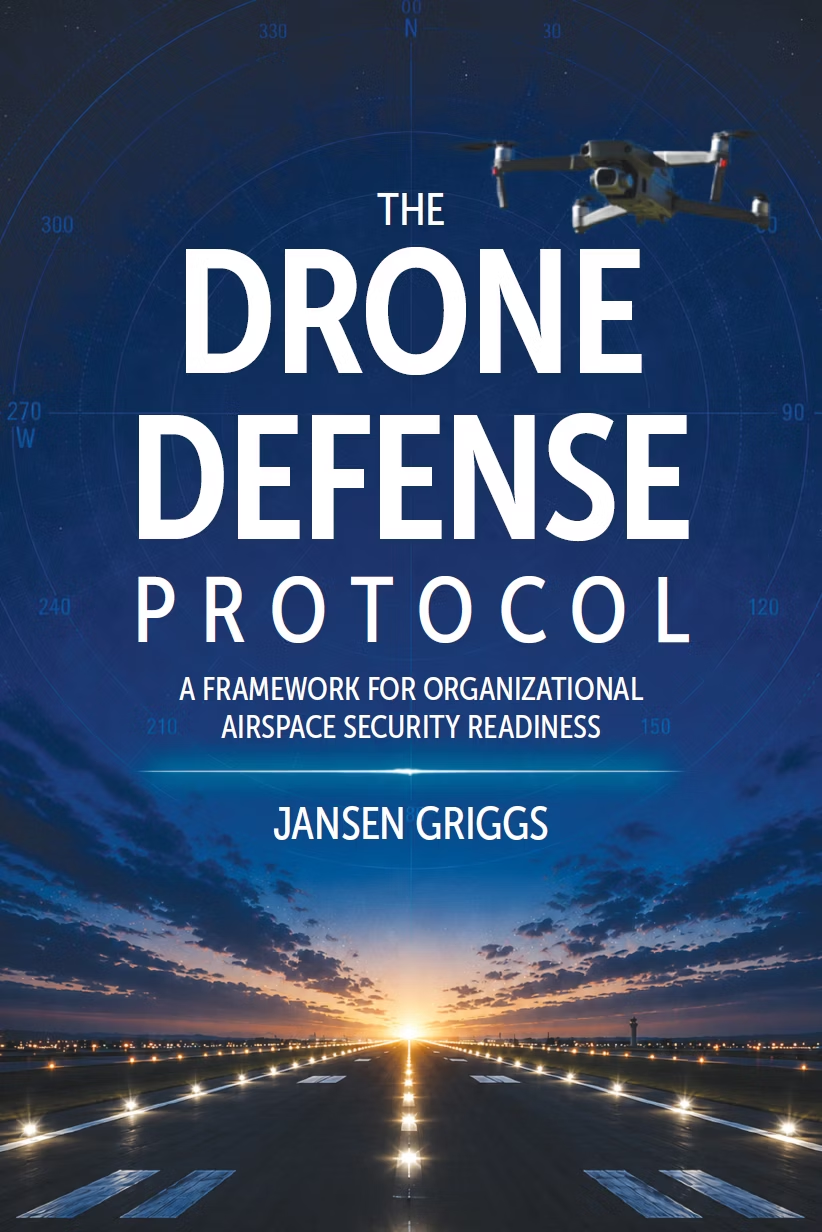
THE DRONE DEFENSE PROTOCOL
A Framework for Organizational Airspace Security Readiness
A doctrine-based framework for law enforcement, critical infrastructure, aviation, and security leaders.
By Jansen Griggs
A Framework for Organizational Airspace Security Readiness
A doctrine-based framework for law enforcement, critical infrastructure, aviation, and security leaders.
By Jansen Griggs
Organizations across law enforcement, critical infrastructure, aviation, and security leadership have invested in drone detection technology.
When a contact appears, the same questions arise that existed before any equipment arrived: What is this? Should I act? Who decides?
The doctrine gap is real. The Drone Defense Protocol closes it.
Phase
1
Train your people to observe, recognize, and report aerial activity before any technology is deployed.
Phase
2
Build layered detection capability calibrated to your facility's specific sensitivity zones and operational consequences.
Phase
3
Apply a four-factor framework to classify every contact as Tier 1 Routine, Tier 2 Elevated, or Tier 3 High, removing ambiguity from the most consequential decision in the response cycle.
Phase
4
Pre-designed actions mapped to each tier classification, operational safeguards, law enforcement coordination, regulatory notification, and authority boundaries, decided before the incident occurs.
Phase
5
Post-incident review that turns every contact into organizational learning, improving detection, assessment, and response over time.

Commanders and supervisors who need a framework their personnel can apply in the field, without a lawyer present.

Security directors protecting energy, water, nuclear, and transportation assets that exist in a complex regulatory and threat environment.
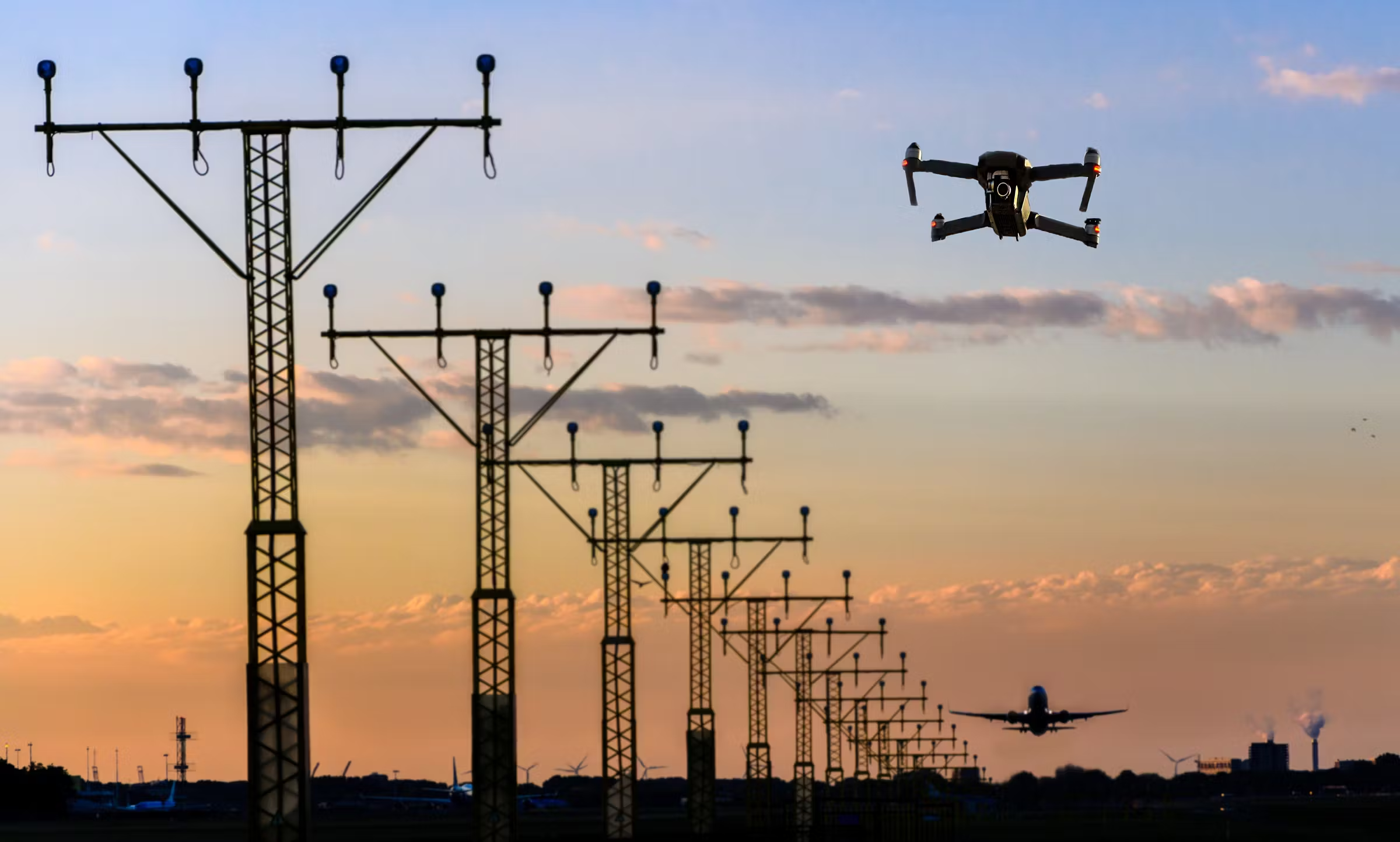
Operations and aviation security professionals managing airspace adjacency on a daily operational basis.
Decision-makers who need to understand what organizational drone readiness requires, and what it costs to not have it.

Jansen Griggs has spent more than 15 years at the operational edge of unmanned aircraft systems and airspace security. Not studying it, but building it, running it, and defending against it.
He led UAS operations during Operation Enduring Freedom, executed one of the nation’s first BVLOS operations for BNSF Railway, delivered enterprise UAS programs at Airware, and founded Air Media Industries with production credits including HBO, Disney, Netflix, and Warner Brothers.
At Los Alamos National Laboratory, he helped build and lead the UAS and C-UAS program from the ground up, including the first-ever C-UAS deployment at a Category 1 nuclear facility and the implementation of an autonomous Drone as First Responder (DFR) docking station program. These are not pilot programs. They are operational systems running in one of the most sensitive security environments in the country.
The Drone Defense Protocol was built from that experience. He is available for consulting engagements and training partnerships focused on UAS and C-UAS program development.
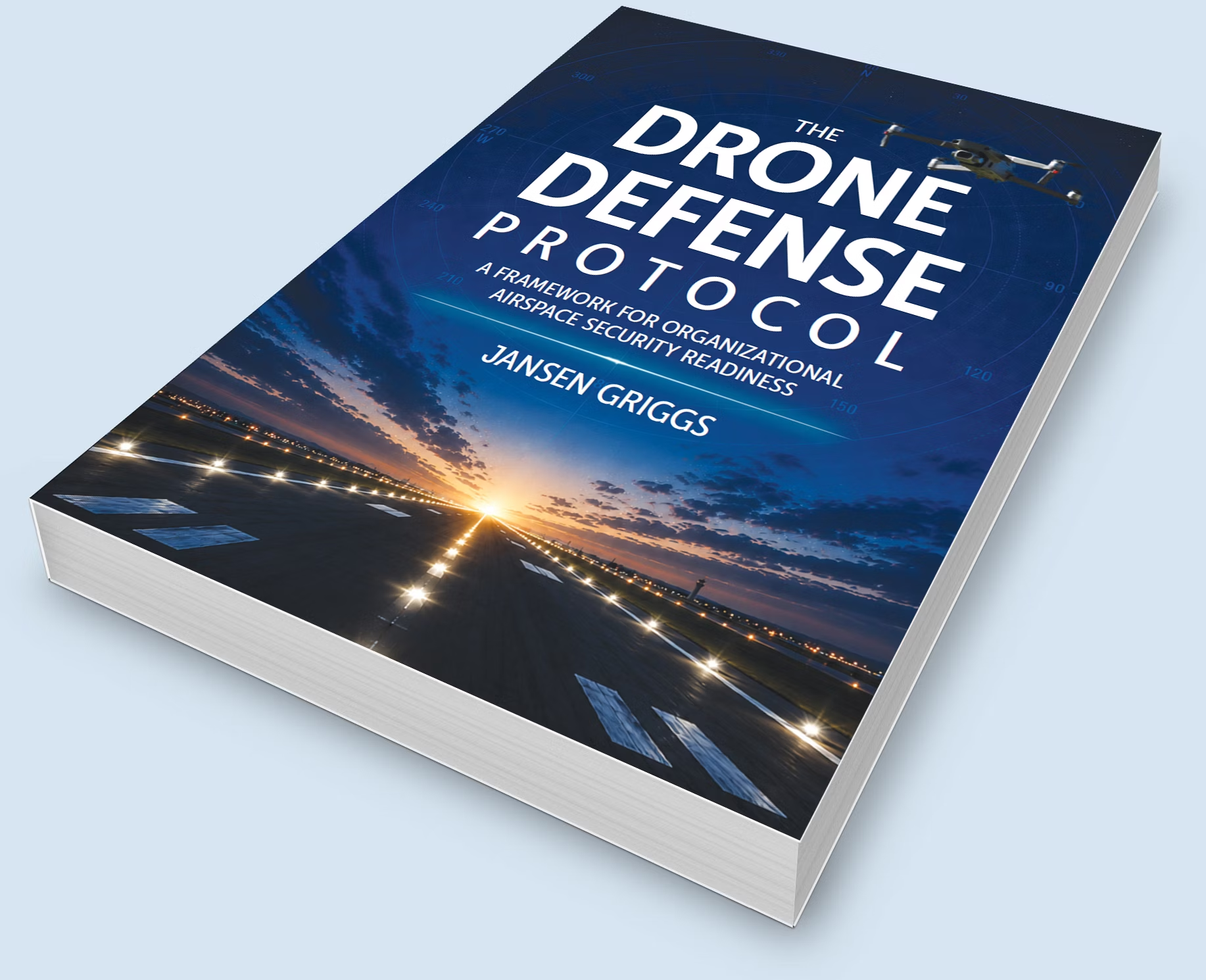
Print and Kindle editions available.
The book provides the framework. Building real readiness inside your organization is a different kind of work, and it’s the work Jansen does directly with clients.
Jansen is available for consulting engagements and training partnerships focused on UAS and C-UAS program development. From initial assessment through program development, training, and ongoing advisory support, every engagement is built around one outcome: an organization that knows what to do before the next contact, not after.
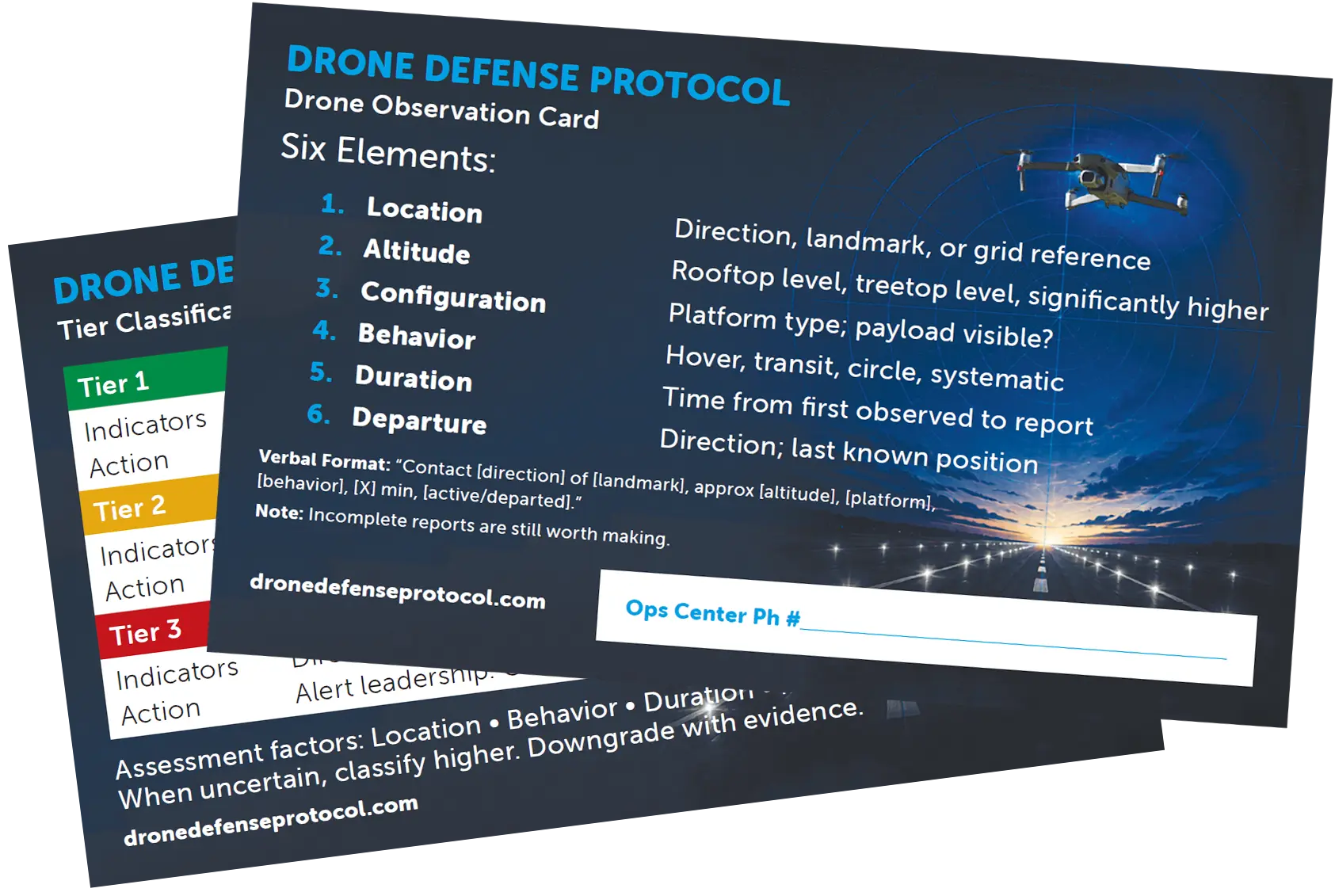
A quick-reference card covering the six-element observation report. Sized for field personnel to carry, designed to help anyone observe and report a drone in under a minute.